
On horseback at Standing Rock, protesting DNB (Norway’s biggest bank) funding for Dakota Access Pipeline. Photo by Adam Alexander Johansson, from YES Magazine.
Here are three great articles from YES Magazine — two of them complete with lists of banks, phone numbers and all you need to take action — to get you started:
People Power: How to Contact the 17 Banks Funding the Dakota Access Pipeline from YES Magazine, published September 29th 2016, shows the starting point for the growing movement to pressure banks to defund Dakota Access Pipeline, called DAPL:
Here are CEO names, emails, and phone numbers—because banks have choices when it comes to what projects they give loans to.
“I Couldn’t Go to Standing Rock, So I Closed My Bank Account Instead,” published just five weeks later, shows activists’ deepening commitment: don’t just call a bank’s CEO, pull your own money out from that bank while you’re at it. The list of banks funding DAPL has grown as well: “There are 38 banks supporting the Dakota Access pipeline. I found out mine was one of them,” begins this essay’s author Cedar Wilkie Gillette.

On October 31st, 2016, demonstrators in the lobby of San Francisco’s Citibank headquarters protest the bank’s funding for Dakota Access Pipeline. Photo: Peg Hunter
Cedar Wilkie Gillette lays out her motivation to act, beginning with water protection and expanding to her experience with North Dakota fracking’s impacts on families and on Native American women in particular, excerpted here:
I am a North Dakota Native on both sides of my family. I was born on Turtle Mountain, my mother’s home; I also grew up on Fort Berthold—the home of my father’s family—which sits at the heart of the Bakken shale boom.
After working to ban fracking on one homeland, in 2012 I began working to help Native American women being directly impacted by fracking on my other homeland, as a tribal domestic violence victim advocate. Thousands of industry workers had infiltrated our reservation and had no place to live, so they populated undocumented, temporary living areas, known as “man camps.” On my second day on the job, I relocated two victims who escaped a man camp that oil workers had prevented them from leaving. They had jumped out a window and walked miles to a police station.
As I continued this work, the unprecedented levels of violence against Native American women only increased. These man camps are also spawned by the Dakota Access pipeline construction.
The movement at Standing Rock unifies and connects our commitment to protect water, climate and future generations with our commitment to indigenous peoples’ rights, human rights, racial and economic justice, and gender justice. That’s what makes this movement so diverse, so unified, and so strong.
POSITIVE RESULTS
All our actions have our deep and thoughtful motivation as one bookend, and results as the other bookend. We don’t always win, and right now the escalating suffering from militarized police assaults and threats from the authorities in North Dakota are intense. But let’s look at and build on positive results — two partial victories unfolding right now:
Norway’s Largest Bank Divests From Dakota Access, Launches Own Investigation (November 17th, Yes Magazine) describes the extraordinary success of the movement to defund DAPL. DNB bank isn’t just divesting, they are investigating. And if the movement has its way, this will only be the first bank to divest from DAPL: “Up to $460 million in credit is still at stake for the Bakken pipeline companies after DNB shed its pipeline assets and has begun a “fact-based evaluation” of indigenous rights abuses.”

Times Square Action Confronts Ares, the Big Money Behind Pilgrim Pipelines. October 26 2016: Photo by Peter Hart, published by Food and Water Watch.
An even lesser-known victory is in New York State where east coast Water Protectors have put in over two years of fierce organizing to successfully hold off the proposed Pilgrim pipelines. Pilgrim would carry both Bakken Shale crude oil and refined products in two pipelines, side by side in the same trench — double risk, double trouble — crossing 256 waterways, including the Hudson River, in New York and New Jersey. Pilgrim’s partial loss of funding is a temporary victory because as soon as Pilgrim finds more funders, they’ll be aggressively pushing forward and we must be ready. But Bloomberg reported this week on Pilgrim’s loss of funding, embedded in their very important story about the Colonial Pipeline disaster, “A Blade Strikes Steel and the Blast Shocks a Nation” (November 23rd):
“Over the past three decades, incidents like these, and the resistance they’ve spawned, have led to a much tighter regulatory environment for pipeline builders. Roger Williams, a pipeline developer from Wichita, said that in the mid-1980s he oversaw a project that laid 1,300 miles of pipe from Texas to California, crossing several states and a mountain range for good measure. At 85, he’s now vice president for operations on the 178-mile Pilgrim Pipeline project, which would serve cities in New Jersey and New York. His team has spent millions just to get to the beginning of the permitting process, including money to hire herpetologists and other wildlife experts to examine the ecological impact of the new line. After more than three years of groundwork, Williams said, “we don’t have one single permit yet.” In the meantime, the company has had to shut down a branch office in New York and lay off its staff. “They protect everything up there except human beings,” he said.”
Since Coalition Against Pilgrim Pipelines in New York (CAPPNY) and New Jersey (CAPP) have done phenomenal work getting over 100 resolutions and ordinances passed opposing Pilgrim to protect human health, drinking water, climate, and the environment in both states (most but not all Resolutions listed here), and have specifically gone after Pilgrim’s major funder, Ares Management and Ares Management EIF Fund, this slowdown in Pilgrim’s funding came as a Thanksgiving surprise. The big action targeting Ares took place while I camped at Standing Rock in October. Several CAPPNY organizers, including Joe Barbarito of New Paltz Climate Action Coalition, Stacy Lipari from Rosendale, Sue Rosenberg of Coalition Against Pilgrim Pipelines-Saugerties, and myself, have traveled separately to Standing Rock to directly participate, donate, build bonds with and support the Water Protectors there between September and November, even while developing the Coalition Against Pilgrim Pipelines back home which continues to make it impossible for Pilgrim Pipelines to be permitted or built.
Right now, in short, the Pilgrims are finding it harder to dominate, while indigenous peoples have captured hearts and minds with brilliant, creative, deeply spiritual and profoundly nonviolent leadership at Standing Rock. It’s up to all of us allies and organizers to build on this positive momentum by standing with Standing Rock, pushing financial institutions to divest and defund fossil fuel pipelines, create climate justice, and protect frontline communities everywhere.
Brutality and Courage at Standing Rock
The dangerous Dakota Access Pipeline, and the brutal repression unleashed on its behalf, is countered by a greater force.

Near the solar panels at Oceti Sakowin camp, Jingle Dress Dancers pause on 10/29 before walking to the bridge, leading a powerful ceremony to reclaim the place where militarized police used 7 weapons against water protectors two days earlier. Photo: Iris Marie Bloom
To me, among a multitude of outstanding positive qualities I was lucky enough to observe continually while camping at Oceti Sakowin camp for one week, the most inspiring aspect of the indigenous-led Water Protectors’ struggle at Standing Rock is courage.

Profile in courage: Storm, shot off his horse with at least three rubber bullets Thurs. Oct. 27th, then trampled by the frantic horse, calmly back on the front lines Sat. Oct. 29th, 2016. Photo: Iris Marie Bloom
That raises the question: why does it take so much courage to protect water, indigenous rights, and sacred sites from the Dakota Access Pipeline? Where is all the violence toward unarmed Water Protectors coming from? Who’s calling the shots? It’s not just the infamous private security firm working for Dakota Access Pipeline which unleashed dogs biting protectors on September 3rd. Another private firm, TigerSwan — which has offices in Iraq and Afghanistan, has been awarded over $57 million in U.S. government contracts, and also close business ties to the oil and gas industry — is working for Dakota Access Pipeline. Here is what Medea Benjamin has to say about TigerSwan:
“It is sad, but not surprising, that this firm has ties to the US interventions in Afghanistan and Iraq,” Medea Benjamin, co-founder of the women-led peace group CODEPINK and the co-founder of the human rights group Global Exchange, told DeSmog. “It is another terrifying example of how our violent interventions abroad come home to haunt us in the form of repression and violation of our civil rights.”
Steve Horn quoted Benjamin in his Counterpunch investigative article, “Security Firm Running Dakota Access Pipeline Intelligence Has Ties to U.S. Military,” published October 31st 2016, while I was still living at Oceti Sakowin camp. Throughout my time at Standing Rock, I kept thinking “these guys behave more like a paramilitary force, this feels more like low-intensity warfare against a whole people,” rather than mere private-property defense in the usual sense. TigerSwan is a key part of the escalated, large-scale militarized police aggression against indigenous people and their allies at Standing Rock.
Grace in the Face of Brutality

Photo and message posted by Steven Bluehorse October 28th 2016
Some of us allies who arrived after police arrested 140 water protectors on Saturday, October 22nd may have had the illusion that the worst had already happened. On Wednesday night, October 26th, after my friends and I pitched our tents at dusk, we were called to the frontline camp — the northern camp known as the “1851 Treaty Camp” which Lakota leaders claimed by eminent domain. These tipis, tents and prayer circles directly blocked the route of the Dakota Access Pipeline, on land the corporation had bought but which was actually owned by the Standing Rock Lakota according to its 1851 treaty with the U.S. government — a treaty broken by the U.S. government.
I took two men to the 1851 treaty camp, all of us trying to figure out if we could be of use amidst rumors that the police assault would happen overnight. When they decided to get some sleep, I brought them back to camp but answered the call when another request went out to bring more Water Protectors to the frontline camp. So I brought two more men to the 1851 treaty camp, and while we assessed the situation one of them, a gentle, soft-spoken Havasupai man — a firekeeper who seemed to never meet a person he did not immediately help in some way — told me his story. He was arrested while engaging in peaceful nonviolent protest on Saturday October 22nd. Thrown to the ground, he found himself motionless on his back while a large policeman ground his knees painfully into his ribs. He heard another policeman screaming at him, “Turn over! Turn over!” which he could not possibly do as the big policeman bore down with rib-cracking force on top of him. Eventually the officer let up his knee pressure long enough to let him turn over. After that he endured two days in jail with no medical care, and here he was on the frontlines.
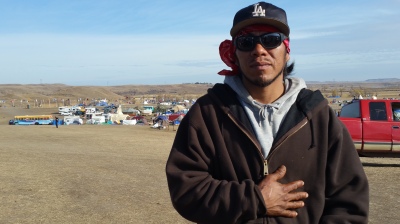
Havasupai Water Protector and Firekeeper, whose ribs were broken by police. Photo: Iris Marie Bloom
Later that same night, my new Havasupai friend stood with me in the cold, cracked ribs and all, while I tried to text-guide an even newer arrival to a tipi where my Lakota friends had offered sleeping space. He stayed patiently for a full hour in the cold and dark until my missing crew member finally appeared, showing above-and-beyond consideration and hospitality in keeping with the theme of the whole camp: we are all Relatives. The next day, I was glad to be of use, taking him to the Indian Health Service in Fort Yates for an X-ray to document the fractured ribs, while the next major police assault was underway.
Mainstream media failed to cover the police and National Guard aggression against the 1851 Treaty Camp Thursday, October 27th, during which police used batons, mace, rubber bullets, sound cannon, tasers, and physical force against people plus taser and rubber bullets (some said live ammunition) against a horse, who later died. Militarized police also rammed a horse with an ATV. Myron Dewey, Indigenous Environmental Network, and other indigenous leaders did an incredible job documenting the assault on Facebook. One non-Facebook site documenting much of what happened that day is Unicorn Riot, with dozens of photographs and video despite Unicorn Riot journalists themselves being assaulted, they reported at about 4:45 pm.
A post from Uncensored News, “Morton County Sheriff and Violent Gang of Police Targeted And Arrested Medics While They Were Treating Patients,” documents the targeting of medics including the moment when a woman medic wearing a red cross, driving a car clearly marked with a red cross, was ripped out from behind the wheel of the car she was driving, thrown down and roughly arrested while the car was still moving, putting many people at risk.
I’ve seen that arrest on video and spoken with eyewitnesses. One of the most disturbing things about it is that a masked man, his face covered with a black mask and goggles so that no skin anywhere on him is visible and his eyes are invisible too, walking in fatigues with the militarized police, shouts “she needs to be arrested.” The officer immediately in front of the masked man obeys the order, abusing the medic and disregarding the safety of everyone in front of the car while he pulls the medic out of the car she is driving. Who is that masked man? Why did police obey him, endangering everyone in the path of the car?

This is a taser barb removed from the cheek of a protester opposing the Dakota Access Pipeline. Posted by Wes Enzinna on Twitter 10/28/16.
All in all, police from multiple states arrested 141 water protectors on October 27th. Over 400 water protectors had been arrested cumulatively by November 1st. Bail was set at 1,500 per person. On Thursday October 27th everyone, including elders praying inside a sweat lodge and a grandma sitting on the ground in a prayer circle — was charged with a felony, igniting an incendiary device, because someone set fire to a DAPL worker’s truck after the DAPL worker, a hired mercenary, attempted to bring 3 guns into the main Oceti Sakowin camp. The BIA (Bureau of Indian Affairs) police arrested the DAPL mercenary without injury after protectors challenged him near the camp. Mother Jones reports the incident in detail: “I watched an armed Dakota Access Pipeline Employee Get Arrested After Entering Protesters’ Camp.”
In total, for Thursday 10/27 alone, the Standing Rock Sioux Tribal Council paid $173,000 for bail and another $80,000 to get back the 100 cars impounded by police near the 1851 Treaty Camp.
The repression didn’t end there. On Wednesday, Nov. 2nd, riot police injured 100 people. Police shot a 16 year old boy with rubber bullets at point-blank range, causing him to cough up blood, Dr. Jesse Lopez confirmed. Lopez examined him on-site. One woman said, “I told the police, ‘I love you,’ and then they maced me in the face for 6-7 seconds.”
On the Sunday before Thanksgiving, police assaults escalated even further. Not only did Morton County Sheriff’s Department and militarized police spray protectors with water cannon in sub-freezing weather, but medics reported that they sprayed mace in such high concentrations in such a short period of time that people lost bowel function, vomited, and one person had a seizure. One elder went into cardiac arrest and had to be revived with CPR. The Water Protectors were nonviolently dismantling the burned trucks sitting on the bridge not far from the main Oceti Sakowin camp, in order to increase the access to the camp for emergency and safety vehicles and in order to stop the police barricade which was inconveniencing local ranchers and area resident when the Sunday night police assault occurred.
Degradation follows Desecration
While all the nonviolent actions have at their heart water protection, on November 2nd, the activists were trying to protect both the Cannonball and Missouri Rivers and the burial grounds on November 2nd. “Riot Police Injure Over 100 People Defending Standing Rock Burial Grounds” quotes LaDonna Bravebull Allard:
They parked their armored cars on the graves of Matilda Gaplin, Eagle that Looks at Woman, and with her are her daughters Louisa DeGrey Van Solen and Alma Parkins who once owned the Cannon Ball Ranch. Next to her is her husband Charles Parker, and 11 babies. These are famous people for us here in Indian Country. Matilda was the only woman to sign the Fort Laramie Treaty of 1868. Louisa was the first school teacher on Standing Rock. I am deeply hurt to see the desecration of their graves.
In “Dakota Access: Women on the Front Lines tell of Violent Arrests and Police Abuse–video” the Guardian reports,
The Native American women leading the Standing Rock protests against the Dakota Access oil pipeline say they have faced police abuse and mistreatment in jail. North Dakota’s militarized law enforcement has left many of them traumatized. ‘They came with their guns, their weapons and violence and put it on a peaceful people,’ says Lauren Howland, a member of the San Carlos and Jicarilla Apache tribes and Navajo Nation.
Strip searches are being used routinely. One 18 year old indigenous woman said, with gracious understatement, “It made me uncomfortable. It hurt my dignity.” As a white woman arrested for nonviolent protests in Florida (opposing the launch of the Trident II D-5 nuclear weapon); Washington D.C. (for sitting down in front of Citibank during anti-apartheid protests and years later for a large gay rights civil disobedience action at the Supreme Court) and Philadelphia (for urging Army Recruiting stations to stay out of Iraq) I have never been strip-searched. Never. Ever. Nor was anyone I was arrested with. Why is North Dakota in general, and Morton County in particular, going out of their way to use humiliation as a tool of repression?
Courage
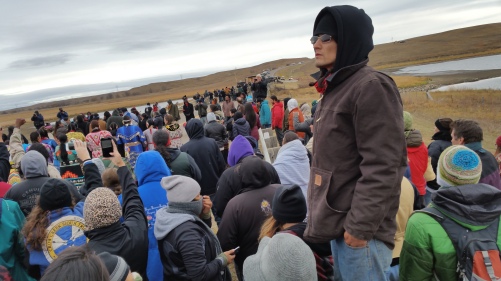
One day after 141 arrests, rubber bullets, mace, tasers, sound cannon and physical force devastated Standing Rock protectors, nonviolent marchers again fill the road. Photo: Iris Marie Bloom
To be honest, I can’t say that I personally was all that courageous during my week at camp. I helped people. I chopped potatoes. I helped elders get needed rest and showers. I listened a lot. I gave all the gifts — insulated winter boots, pre-paid VISA cards, cash, sub-zero winter sleeping bag, coffee, sugar, good winter coats and other winter gear — with which people in the Hudson Valley of New York, especially folks fighting the proposed Pilgrim Pipelines, showered me before I left — focusing on support for long-term campers, not weekend visitors. I gave rides. I helped a few people figure out where the medic tent was and how to get the help they needed. I helped Helmina Makes Him First buy supplies for fry bread and soup she brought to Winona’s Soup Kitchen, a traditional Lakota kitchen which feeds 350 people a day. I went to the front lines a bunch of times but was never there when the rubber bullets were flying. No wounds, not even a little mace, and no strip-searching for me. Just a lot of smoke — sage and firewood — in my eyes.
But courage was all around me, all the time.

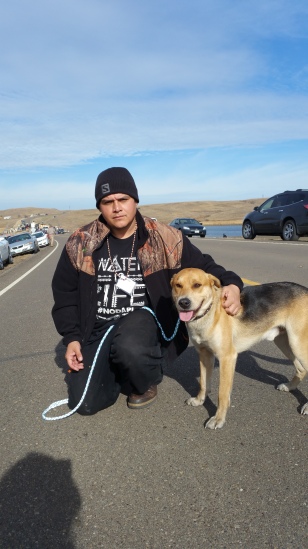
This Water Protector had to pay $110 to free his dog, impounded by police on 10/27. Photo: Iris Marie Bloom
Courage filled the feet of Abe, a Lakota man of the Cheyenne River band, so elderly that his grown daughter, Winona, tried to make him agree to stay away from the front lines. But Abe was always at the frontlines, no matter that walking was difficult for him.
Courage filled the voices of all those who defused the dangerous situation where a DAPL security worker who brought three weapons and tried to enter the main camp; Ryan Redhawk narrates that conflict in full here.
Courage filled the hearts of all the water protectors who attempted to protect the Standing Rock burial sites and sacred sites from DAPL bulldozers on September 3rd, enduring mace and terrifying biting dogs, but who pushed back with nothing but their bodies and their shouts.
Courage filled the life of Caro Gonzales, member of the Chemehuevi Tribe, who in spite of the advancing lines of police, told the police “those are grandmothers’ bones you are digging up,” praying and attempting to offer tobacco, as a prayerful offer to the Creator. Police stomped her arm “trying to get the tobacco out of my hand,” Caro said.
Courage filled the mind of Lauren Howland, Indigenous Youth Council leader, who speaks directly about racism towards indigenous spiritual practices: “If I was white, if I was a white priest, I would not have been arrested… Are they going to come beat me again?”
“Two women told me to take my clothes off… I asked them to look away, they said we’re going to stand here and watch you… I said I’m sorry but I’m not going to do that for you. They dragged me into another cell with male officers, where they ripped my clothes off of me…. Now I don’t remember everything, from then I was traumatized, I have flashes remembering….” Listen to the courage in the voices of the women.
Eviction Notice: Forced Removal Threatened
Yesterday, Friday November 25th 2016, the day after Thanksgiving, the Army Corps of Engineers gave an eviction notice for the whole main Oceti Sakowin (Seven Council Fires / Great Sioux Nation) camp. Both Dave Archambault of the Standing Rock Sioux Tribe and the Cheyenne River Chairman Frazier wrote eloquent letters calling for the Army Corps to protect the water and human rights by rescinding permits already given to DAPL and by refusing to give the final easement DAPL needs to bore under the Missouri River, rather than by enacting yet another forced removal of indigenous peoples from their own lands, promised to them by treaties never honored.
But the day before the eviction notice would take effect, hundreds of veterans who have served in the U.S. armed forces will arrive at Oceti Sakowin camp. And the camp has already grown to about 3,000 participants following the brutal crackdown with mace, rubber bullets, water cannon and concussion grenades on Sunday night November 20th. The courage, compassion, spirit, creativity, resilience and persistence of the people, indigenous-led and ally-rich, continues to grow.
I literally can’t stop talking about the struggle at Standing Rock, as everyone who knows me knows. I felt there was no way to begin this post without looking at centuries of racism and genocide as context for the struggle; and no way to end it without honoring the veterans who will soon be arriving at Oceti Sakowin camp. For the Lakota and 300 other indigenous nations at Standing Rock; for the veterans about to arrive to join them, this is the time to stand for cultural survival, water, honoring the treaties, human rights, justice and morality:
A Facebook page for the event, Veterans Stand for Standing Rock, has more than 600 confirmed reservations with more than 4,500 other people expressing interest.
High-profile veterans including U.S. Rep. Tulsi Gabbard of Hawaii and retired Baltimore police officer/whistleblower Michael A. Wood, Jr. plan to attend.
“This country is repressing our people,” Wood Jr. told Task & Purpose. “If we’re going to be heroes, if we’re really going to be those veterans that this country praises, well, then we need to do the things that we actually said we’re going to do when we took the oath to defend the Constitution from enemies foreign and domestic.”
The “operations order” states:
“In response to the assertion of treaty rights, citizen rights, tribal rights and protection of the most valuable of resources, water, the Sioux tribes and allied comrades, are under sustained assault by agents of and working for private interests under the color of law. First Americans have served in the United States Military, defending the soil of our homelands, at a greater percentage than any other group of Americans. There is no other people more deserving of veteran support and this situation encapsulates whether we are called heroes for violence and cashing paychecks or for justice and morality.”
From Hundreds of Veterans to Join Water Protectors at Standing Rock to Protest Dakota Access Pipeline (EcoWatch).
http://www.ecowatch.com/veterans-standing-rock-dakota-access-pipeline-2106672407.html

Another Water Protector Bound for Standing Rock
The call to Stand With Standing Rock is a call to hearts and minds everywhere.

Water Protectors at Standing Rock: “Respect Indigenous Rights,” “Defend the Sacred,” “Water is Life.” Women on front lines. Photo from Democracy Now, October 17th 2016.
Allies are needed at Standing Rock in North Dakota. Civil rights violations perpetrated by the Morton County Sheriff’s Department are escalating along with increased surveillance and militarized police aggression, while water, land and people are threatened by the Dakota Access Pipeline, and treaties made with First Nations have never been honored. I will head out with a small crew, to take a stand for Standing Rock, next Monday, October 24th, assuming my bronchitis eases up — don’t tell me, I know it’s cold out there — after helping with fundraising, action alerts, and shipments of sleeping bags, warm blankets and coats, first aid kits and herbal medicines requested by the medics at Standing Rock in September and October.

From Indian Country Today, Courtesy of Indigenous Environmental Network: Young Rita Waln led a procession of women and children who shook hands with officers at the ND Capitol after they held a demonstration to deny charges that weapons or pipe bombs were at the Lakota encampments along the Missouri River. About 200 water protectors took their message of peace to the governor that they are unarmed and peaceful. August 23rd, 2016.
How can you help Standing Rock? First, stay informed: watch the Monday, October 17th 2016 Democracy Now episode where Amy Goodman films peaceful Water Protectors facing militarized police; interviews Standing Rock Sioux Chairman Dave Archambault II, as well as Honor the Earth’s Winona LaDuke and Tara Houska: “Dakota Excess Pipeline? Standing Rock Protectors Strip-Searched, Jailed for Days on Minor Charges.”
Next, make four phone calls. Call Morton County Sherriff’s office (701) 667-3330 to demand the rights violations cease. Democracy Now reported this morning (link above) that the Morton County Sheriff’s department strip-searched the daughter of LaDonna Bravebull, the Sacred Stones Camp founder, in front of several male officers and left her naked in a freezing cold cell for hours. They asked her, “who’s your mother?” This sounds like torture, not community protection or upholding the law. Intimidation on behalf of Energy Transfer Partners, the company trying to build a massive Bakken Shale fracked oil pipeline just feet from the Standing Rock Sioux Reservation, threatening the Missouri River and the reservation’s drinking water as well as every community downstream.
Next call North Dakota Governor Jack Dalrymple (701) 328-2200 and President Obama (202) 456-1111 or (202) 456-1414 to demand the Dakota Access Pipeline construction cease permanently and to demand an end to human rights abuses: protect the Water Protectors, don’t abuse them! Finally call the Army Corps of Engineers (202) 761-5903 to thank them for temporarily refusing the permit for the Dakota Access Pipeline to drill under the Missouri River, and to urge them to make that permanent.

Photo from Indian Country Today, courtesy Indigenous Environmental Network. After Morton County Sheriff Kirchmeier said his agency received reports of pipe bombs [which turned out to be nasty rumors planted when water protectors discussed peace pipes], Lakota people firmly denied those allegations and sent peaceful messages from elders, youth and women. August 23rd, 2016.
Expressions of solidarity with Standing Rock are extraordinary. It is a time to unify and celebrate as well as to stay informed, take action, donate, and resist.

Members of the One People One Canoe Society stand outside the Standing Rock Sioux Reservation with the Raven Canoe from Juneau, Alaska on September 6th, 2016. The group made a journey of thousands of miles to North Dakota to join in the protest against the Dakota Access Pipeline. Photo: Morgan Fawcett. Read Story: Jill Burke at adn.com
Many Fronts: From Pilgrim Pipelines and Dakota Access Pipeline to Frontline Communities Everywhere
In this phase of the fight for climate justice, clean water and human rights, we need to become adept at working on several fronts simultaneously. The fight against the Dakota Access Pipeline’s East Coast counterpart, Pilgrim Pipelines — proposed to carry Bakken Shale crude out of Albany, NY brought to Albany from North Dakota’s fracking shalefields by oil “bomb trains,” — continues. Please prepare now to write your own public comments during the scoping phase of the New York State Environmental Quality Review, to begin imminently. Check the Coalition Against Pilgrim Pipelines website frequently, along with Riverkeeper, Scenic Hudson, and Protecting Our Waters, for updates.
We take leadership from indigenous people, people of color and frontline communities, which now also include massive numbers of white and middle-class communities. Frontline communities are those directly facing fracking, mountaintop removal, tar sands extraction impacts, spills and explosions from existing and new shale oil, dilbit, gasoline, fracked methane, and fracked NGL pipelines; polluting refineries, compressor stations and pump stations, export facilities on all our coasts, and bomb trains.
Ultimately, while the sheer number of frontline communities expands, we are one people in one struggle for a sane, liveable, humane future for ourselves and all species. The fight for dignity, sovereignty, human rights, climate justice, human and ecological health, and at the core, clean water, sacred water, at Standing Rock is everyone’s fight.
Follow Your Heart
You can donate directly to the Standing Rock Tribal Council here.
If you know me from my seven years’ anti-fracking and anti-pipelines work to protect water, health, climate, and human rights (or from my decades of work for nonviolence, against sexual assault; for peace, against racism, for indigenous peoples’ rights, before that), and would like to support this trip, please call (215) 840-6489 [cell] and (845) 687-7810 [land], to learn how to donate. Please leave your name and return call number(s) on both lines. I know it’s a pain, but we want to be secure and do not have a way to accept credit card donations. Thank you for considering supporting this little crew. Protecting Our Waters has been saying for 7 years that we — and you — are Protectors, a word now heard around the world as the Lakota Water Protectors hold the front line. The concept for the founding of Protecting Our Waters came directly from the Thirteen Indigenous Grandmothers, who said: “Protect something. Pick something — seeds, land, a species, a place, a waterway — and protect it.” It’s simply what we all need to do.
The call to Stand With Standing Rock is not just about action, money, or sharing online information. It’s also about prayer. The Standing Rock Tribal Council continues to ask everyone to send prayers. They are asking explicitly, they are asking continually, and they do not ask what tradition you come from or whether you’ve ever prayed before. Don’t know how to pray? Watch. Listen. And as Standing Rock Tribal Council member Cody Two Bears puts it, “Follow your heart.”
Rensselaer Unanimous: No Pilgrim Pipelines
Rensselaer, NY: On Wednesday, July 20th the City of Rensselaer Common Council voted 5:0 to pass the Resolution Opposing Pilgrim Pipelines, becoming the fourth and final city on the proposed oil and petroleum products pipelines’ direct route to oppose permitting or construction of the pipelines. The cities of Albany, Kingston and Newburgh had already passed Resolutions Opposing Pilgrim pipelines. The Common Council found opposition to Pilgrim pipelines running 21:1 in the city of Rensselaer.
Rensselaer is now the 28th Hudson Valley municipality (including towns, cities and villages but excluding counties) to pass a resolution opposing Pilgrim pipelines due to health, safety, environmental, drinking water, climate and energy policy, and economic concerns. The total proposed Pilgrim pipelines’ length, including laterals, is 352 miles in both states. Both proposed pipelines would be drilled horizontally underneath the Hudson River twice.
Common Council President Brian Stall commented, prior to the vote, “The area [of Rensselaer] along the port is heavily contaminated, DEC [New York State Department of Environmental Conservation] wouldn’t allow several tree stumps to be dug up there because it’s too contaminated. If DEC won’t allow tree stumps to be dug up, why would they allow huge pipelines to be drillled and dug there?”

Rensselaer Resident Joanne Farrell addresses Rensselaer Common Council on July 20th. Photo: Iris Marie Bloom
Five voted “AYE” to the Resolution Opposing Pilgrim Pipelines: James Van Vorst, John DeFrancesco, James Casey, Margaret Van Dyke, and Common Council President Brian Stall.
Two abstained: Dave Gardner, who said he “wanted to hear from DEC,” and Richard Mooney.
“We have an historic town. This river has shaped the lives of everyone who ever lived here,” said Rensselaer resident Joanne Kathleen Farrell, of Rensselaer Community Action, She told the Council, “There would be five times more oil trains if these Pilgrim pipelines are built, and Rensselaer is in the blast zone [for oil train explosions]. We fish, we boat and we picnic by the river. We may not be the richest, but we’re not tolerating this attack on our environment, our river and our city.”
“A pipeline like this leaks every 30 hours, according to federal data,” Reverend Barbara Toll, pastor of the United Church of Christ in Rensselaer, testified at the Common Council meeting. “Last year, a pipeline like this leaked 60,000 gallons of oil into the Yellowstone River. How much oil would leak, how much damage to the Hudson River would occur before we even know?”
“According to PHMSA [Pipeline and Hazardous Materials Safety Administration], there have been 631 pipeline incidents per year for the past ten years,” Reverend Toll continued. “I don’t want this kind of risk for my congregation. Creation care is a faith issue for us. Our climate requires protection. We need a cleaner, healthier future for our grandchildren. In the City of Rensselaer, we can actually say no to this thing. Let’s say no tonight!”
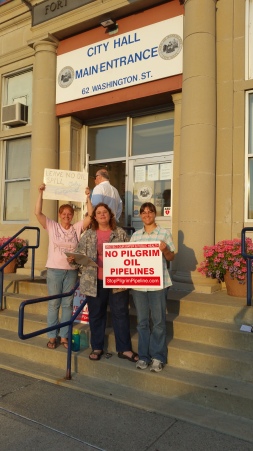
After July 6th Rensselaer Common Council meeting: Joanne Farrell, Grace Nichols and Andrea McFarland. Photo: Iris Marie Bloom
By passing the Resolution Opposing Pilgrim Pipelines, Rensselaer joins Albany and the towns of East Greenbush and Bethlehem in united opposition to the proposed Pilgrim pipelines throughout the Capital District, in every Capital District municipality along the direct proposed pipelines route. Several Capital District residents also spoke.
Tina Lieberman, an Albany resident, described and countered statements she said Pilgrim Pipeline Holdings LLC’s lobbyist in Albany, John Casellini, had made in Albany: “Casellini assured ‘the latest in anti-leak technology,’ but why are there so many leaks in new pipelines? It’s because sensors don’t go into effect until there’s a major drop in pressure. The Keystone pipeline leaked for a week before it was noticed — and then it took Transcanada ten more days to find the leak. Don’t be bamboozled!”
Lieberman added, “Casellini said in Albany there would be about four to five jobs in our area [with 40 – 50 pipeline jobs spread out from Albany to Linden, NJ]. We can create more, safer, good clean energy jobs. Don’t let them take away our air, our water, what we value most about living here!”
Peter Cook, Executive Director of NYS Council of Churches, representing over 7,000 congregations, testified at the Rensselaer Common Council, “I’m also a pastor for the United Church of Christ, which did a study showing that where people of color live and where there is a higher level of poverty, environmental harms proliferate, causing health harms. These pipelines represent disproportionate risk with no benefit. Please join 27 other cities, towns and villages in passing this Resolution tonight.”
Dave Publow, of neighboring Troy, said, “Pilgrim pipelines is a 19th century project using 20th century technology and does not meet 21st century needs. As to climate, we’re out of time. Each month is getting hotter than the last. There’s no reason for us to bear the brunt of these bomb trains running right next to African American and low-income neighborhoods. This project is toxic, and we need to stop it.”

Kayacktivists at Rensselaer boat launch during Breakfree in May 2016, near where Pilgrim Pipelines would be drilled under Hudson River. Photo: Iris Marie Bloom
At least eighteen people testified at the Common Council meeting. At least fourteen strongly opposed the Pilgrim pipelines.
Four people, including lobbyist John Casellini, testified in favor of the pipelines; at least two of those represented Local 190, calling for construction jobs.
Sue Rosenberg, of Coalition Against Pilgrim Pipelines-Saugerties, said, “We want good union jobs…. I know how hard it is. We need to create jobs building clean energy sources, to fix our bridges and railroads. We are downriver– so a breach in these pipelines would travel in a hurry to us.”
The controversial pair of proposed Pilgrim pipelines would carry Bakken Shale crude oil from Albany to Linden, NJ. Pilgrim’s construction would require an increase in oil train traffic into Albany threefold to fivefold, compared to the current (fluctuating) number of oil trains entering Albany, in order to service the southbound crude oil pipeline.

Riverkeeper documented the Rensselaer vote here: Capital Region Unanimously Opposes Pilgrim Oil Pipelines
Rensselaer Residents Speak Out Against Pilgrim Pipelines
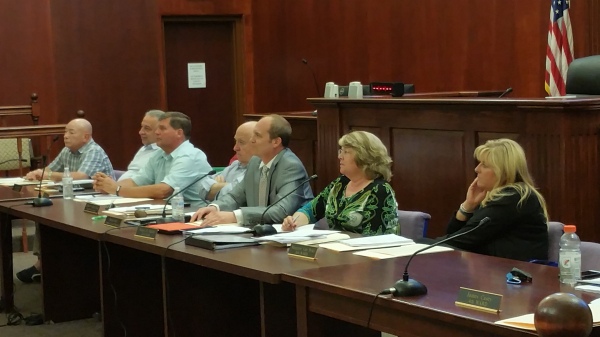
City of Rensselaer, New York: Common Council listening to residents’ testimony opposing Pilgrim Pipelines at Public Hearing June 15th 2016. Photo: Iris Marie Bloom
Rensselaer, New York “We have to put our foot down,” said Pablo del Gallego, who literally had the last word at the City of Rensselaer’s Public Hearing on the proposed Pilgrim Pipelines this Wednesday, June 15th. “Oil is on the way out. Being a taxpayer, homeowner, etc. here, I don’t like these pipes, they will break and fail,” Pablo predicted. Rensselaer’s Common Council listened closely, having organized the Public Hearing to “take the pulse” of the community.
Rensselaer Common Council meetings normally draw three to five residents, but

Packed hall: Rensselaer Public Forum on Pilgrim Pipelines 6/15/16. Photo: Iris Marie Bloom
residents packed the small City Hall to speak about the Pilgrim oil pipelines. Common Council President Brian Stall called for those in favor of the pipelines to speak first, and only one resident spoke in favor, hoping for construction jobs. Another construction trade union representative spoke next, also in favor; he was not a resident of Rensselaer.
Then 16 opponents of the proposed pipelines spoke, and it became clear that Rensselaer is an environmental justice community whose residents are deeply fed up with polluting industries being imposed on them.
Environmental Justice Rensselaer Style
Michelle, who identified herself as living near the co-generation plant, as part of her testimony opposing the pipelines, said, “I ask you to stop these Pilgrim pipelines. But I can see why a lot of people have given up. I’m tired, my health is failing, the fumes affect me day and night. My doctor said, ‘you don’t smoke enough to have emphysema.’ I have to close the windows, I can only sit outside at best 3, 4 times a week. Now if these Pilgrim Pipelines come, do I have to get rid of my house? I can’t leave my house to my kids with all this smoke and pollution from the cogeneration plant and the asphalt plant.”
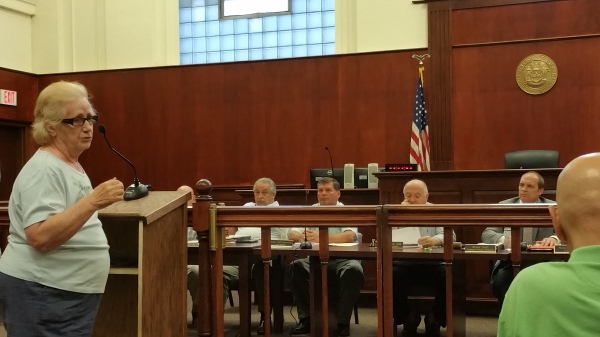
“We need to protect our city,” Marion Webber told Rensselaer’s Council at the 6/15 Hearing
Former Ward leader Marion Webber spoke in opposition to the proposed oil and petroleum products pipelines which would be drilled under the Hudson River from Albany, under the City of Rensselaer waterfront and under the city itself, if permitted. “Most of our children have asthma,” she said. “If there’s any money [from Pilgrim], I hope Rensselaer turns it down. We need to think about our future. We need to protect our city so our children have someplace to grow up into!”
A Harvard analysis, “OIL: the Life Cycle Analysis of its Health and Environmental Impacts,” supports Marion and others who commented about health impacts.
Another Rensselaer resident commented, “I moved here eight years ago to enjoy the waterfront and raise my children. But now with the industrial projects, trucks are shaking the house– I can’t even keep pictures straight on the walls. Please protect our environment and our community!”

Pilgrim pipelines opponents Pam Ross, Mary Finneran, and Deb Guard at Rensselaer Hearing
“Bakken Crude is Notoriously Degrading to Pipeline Infrastructure”
Louis Sebesta, a resident of Partition Street in the City of Rensselaer, declared, “I oppose the Pilgrim Pipelines. They would carry Bakken crude oil, which is extremely corrosive and volatile. Bakken crude is notoriously degrading to pipeline infrastructure, leading to higher risk of pipeline leaks. And the construction alone would be devastating to our already hurting community. The trucks would be thundering, booming, dusty and degrading our already damaged air quality.”
Regarding the jobs argument, Louis said, “These jobs are boom-bust short-term jobs which go to out of town workers, pipeline jockeys, from the South and from Texas. And green jobs are highly labor intensive, unlike fossil fuel jobs. Green jobs are the jobs of our future.”
Many people, including Kate Hudson, Director of Cross-Watershed Initiatives for Riverkeeper, testified about the physical dangers and the extreme threats posed by drilling two pipelines– one would carry crude oil, and one would carry refined petroleum products — under the Hudson River twice.
“Pipelines spill three times as much oil as oil trains,” commented Hudson. “And oil trains would increase in order to service these pipelines. That affects Rensselaer because Rensselaer is within the blast zone for an oil train explosion.”
Kate Hudson pointed out that new pipelines leak at a tremendous rate: “The Keystone pipeline leaked 35 times in its first year of operation.”
Regarding the likelihood of leaks from the Pilgrim pipelines, Hudson said that “a 168,000 gallon leak is the best-case scenario,” based on the flow of oil and refined products through the pipelines. If not stopped instantaneously in the unlikely best-case scenario, she said, “the pipeline will be leaking at a rate of 357,000 gallons per hour.”
A Rensselaer resident put it poetically: “I believe the river is a gem to be protected, not a resource to be exploited.”
Rensselaer resident Deborah testified, “We are just starting to bring people back to the waterfront. Why put our river, our waterfront and our city at risk?”
Voices Not Present: “Your Children and My Grandchildren”
A crew of downriver Pilgrim pipelines opponents, including this blogger, walked the parks, cafes, streets and sidewalks of Rensselaer for several days prior to the hearing. The blue-collar community members’ most frequent response to the hearing invitation emerged, “I’m working two, three jobs. I’m working that night.”
In the face of a tough series of losses this community has already endured, the strong turnout and lively testimony at the hearing gave heart to residents who don’t feel their voices have been heard in the past. “OK, let’s have a meeting!” urged Marian, the former ward leader, on the sidewalk after the hearing. “Let’s decide what we’ve got to do!”
Some made phone calls or wrote to the Common Council to make their views known. Rensselaer is directly across the Hudson River from the City of Albany, which voted 9:0 in favor of the Resolution Opposing Pilgrim Pipelines on May 16th, just one month before Rensselaer’s hearing.
The two cities are part of the Capitol District; their fates are linked. So Jeanette Rice, a resident of Rensselaerville across the river from Rensselaer, wrote the Common Council on June 15th to make sure they understand that climate matters:
To the Common Council, City of Rensselaer,The Pilgrim Pipelines proposal is contrary to the PSC plan to have NYS’s energy supply to be 50% fossil free by 2030. Your children and my grandchildren need to be protected from the impacts of climate change by your responsible actions. PLEASE reject the Pilgrim Pipeline proposal! Please take responsible actions and transition from fossil free fuels NOW.Remember all the explosions from this Bakkan oil. Please do not be rolled over by the promise of money/jobs when clean water, air, soil, life are at stake.We are coming up on the 3rd anniversary of the explosion in Lac Megantic, Quebec where 47 people were incinerated. Please DO NOT support this horror for Albany and Rensselaer. It is your responsibility.Just as we transitioned from sea oil to land oil in the 1850s, we are well beyond time to transition from land oil to renewables.Thank you.Jeannette P. RiceRensselaerville
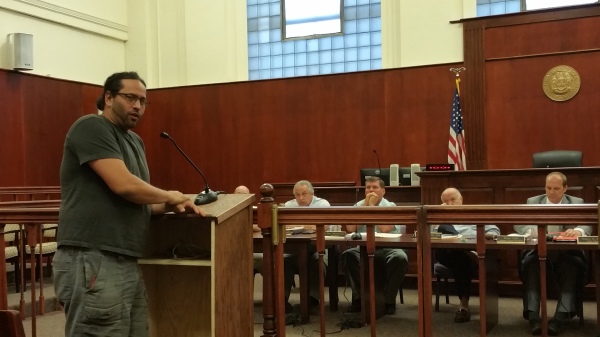
Pablo del Gallego speaks against the Pilgrim pipelines at Rensselaer Public Hearing June 15th 2016. Photo: Iris Marie Bloom
On Wednesday night, June 15th 2016 in the City of Rensselaer, home to Monolith Solar and Garelick Farms among other successful businesses, it was Pablo del Gallego, sixteenth to testify, who had the last word.
“Look upon the future, not just one day, one year, ten years,” he told the Common Council. “We have to look further than that. We have to put our foot down.”
New Divestment Campaign: Pilgrim Pipelines and Ares
The Village of New Paltz and the Town of Rosendale, both in Ulster County, have asked New York State to divest the Pilgrim Pipelines from the state pension fund.
The campaign to divest from the proposed Pilgrim oil pipelines centers on Ares Management. The Ares EIF Management V account provides the funding for Pilgrim Pipeline Holdings LLC, a Connecticut-based corporation whose principals are both former Koch Industries executives, to move forward with its work — including heavy lobbying in six New York counties and aggressive landman tactics in at least five counties — to get permits for their proposed pipelines while setting the stage for eminent domain taking of private property.
About 95 miles of the pipelines’ proposed route would be along the New York State Thruway, I-87, while about 25 miles of the pipelines’ route in New York State would go through private property.
The Town of Rosendale passed its resolution last week. The Tuesday June 7th Daily Freeman quoted Rosendale Councilwoman Jen Metzger describing their rationale for the action. Metzger said the Ares EIF Management V account should not be part of a taxpayer-funded portfolio:
“The state Comptroller has exercised his authority in the past in an effort to ensure that the practices of companies benefiting from State pension fund investments are more consistent with the public interest,” she said.
“Comptroller (Thomas) DiNapoli has been particularly vocal about climate and environmental issues,” Metzger said. “We wanted to put the Pilgrim pipelines project on his radar and urge him to take a hard look at funds being used to back a crude oil pipeline project that a number of municipalities participating in the state retirement system have formally opposed. This project directly contradicts state clean energy goals and puts our local communities and resources at unnecessary risk.”
Read the full story: Rosendale becomes second Ulster municipality to ask state to divest Pilgrim pipelines from pension fund
Pilgrim’s two proposed pipelines would be drilled under the Hudson River twice and would be drilled under or through 232 other waterways, threatening drinking water for millions. As proposed, the southbound pipeline would carry 200,000 barrels per day of Bakken Shale crude oil, requiring a fivefold increase in the number of oil “bomb trains” coming into Albany every day to service the pipelines, which would run between Albany and Linden, New Jersey. The northbound pipeline would carry refined petroleum products including gasoline, diesel, jet fuel and kerosene. The flow of the northbound pipeline could be reversed, and the type of fuel carried in each pipeline changed, after permitting and construction.
Pilgrim has no known contracts with refineries in the Linden area, leading to speculation that the pipelines could be used primarily for export, whether from the beginning or later. It became legal to export U.S. – produced crude oil last fall thanks to intense lobbying by the Koch Brothers, among other major players.
Community to Council: “We Aim to Stop These Pipelines”
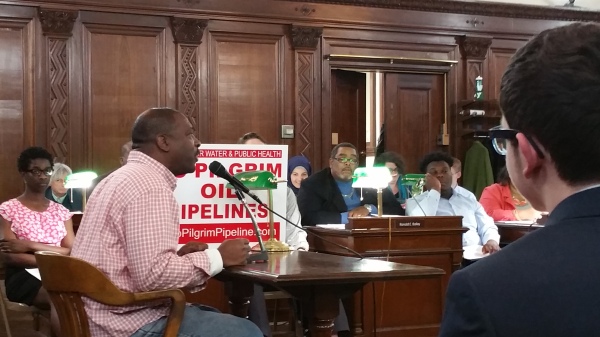
Willie White, AVillage Executive Director, testifies against Pilgrim pipelines. Photo: Iris Marie Bloom
The City of Albany Common Council voted on Monday, May 16th to oppose the Pilgrim oil pipelines, two proposed pipelines which would begin and end in Albany, New York. A standing-room-only crowd, 18 of whom testified against what one speaker called the “preposterous Pilgrim pipelines,” packed into City Hall at 7 PM. The energetic crowd, including Ezra Prentice Homes residents, faith leaders, union members, health professionals, and environmental and climate justice advocates, toughed it out in the increasingly warm and airless chamber until the vote was called at 11:15 PM. “That was a real nail-biter,” commented Albany resident Roger Downs, Conservation Chair, Sierra Club Atlantic Chapter, after the vote. Downs had been the first to testify in favor of the Resolution Opposing Pilgrim Pipelines, more than four hours earlier.
“I’ve never seen as grave an injustice as I’ve seen at Ezra Prentice Homes,” testified Willie White, AVillage Executive Director, referring to the residents in a predominantly African American neighborhood in Albany’s South End, where oil trains rumble 30 feet from a children’s playground while off-gassing from the Global facility and oil trains has led to negative health impacts. “We’ve already got the oil trains, hundreds of diesel trucks, Route 787, Global’s oil heating facility… It’s a travesty. If we really take a moral look at this, it’s not just a dollar bill, it’s people’s lives. We have a right to clean water too, clean air too, and we aim to stop these pipelines.”
Time-Warner Cable posted video of Willie White speaking during the extraordinary Common Council meeting: Albany Common Council Opposes Pilgrim Pipelines.
“We Should Not Increase the Risk”
The oil trains currently carrying about 35,000 barrels per day into Albany would “quintuple” in order to service the Pilgrim oil pipelines if they were to be built, according to research presented by Stephen Shafer, MD, MPH, to the Common Council.
Albany resident Gregory Bell told the Council, “Albany is struggling financially. From a budget perspective, any substantial spill or exploding rail car would be too costly. The Kalamazoo [River in Michigan] cleanup has cost $3 billion so far, and it’s not over. The cleanup cost in Lac Megantic [Canadian town destroyed by an oil train explosion] is $2.7 billion so far. Should Pilgrim pipelines be built, we would see a four to six times increase in oil train quantity here. We should not increase the risk. This Council should pass this Resolution.”
Sitting in rows, standing wherever space appeared, and even sitting on the tile floor, community members clapped frequently after residents’ testimony, despite repeated admonishments from the Council leadership not to clap.

Albany residents clapping after testimony opposing Pilgrim oil pipelines. Photo: Iris Marie Bloom
It’s Our Health: Environmental Racism and City-Wide Impacts
Health concerns and environmental racism related to the proposed Pilgrim oil pipelines took center stage throughout much of the night.
Portia Gaddy, an Ezra Prentice resident for 15 years, said, “I want to be part of the Committee to stop the pipelines, part of the work, because I’m going through health issues. I’ve got children, grandchildren with asthma. I love my surroundings but I can’t live with my surroundings… I’m a victim, I’m affected. Everywhere you turn, there’s trains.”
The fourth person to testify, Deneen Carter-El, an Ezra Prentice Homes resident, said, “My biggest concern is the health problems: cancer, asthma, respiratory, sinus. I’ve lived there over 20 years, and I don’t want this in my backyard. Trains are running again despite the [Breakfree Albany] rally and I don’t want them any more. We have thousands of residents: elders, children, people with disabilities.”
Two days before the Albany Common Council vote, 2,000 people rallied in Albany to “break free” from fossil fuels, with 500 marching through the Ezra Prentice Homes neighborhood in solidarity and support, hundreds more risking arrest on the bomb train tracks at the Global facility where Pilgrim pipelines would begin and end. Five were arrested while blocking an oil bomb train in Guilderland, just north of Albany.

Breakfree Albany Rally in front of Ezra Prentice Homes May 14th. Photo: Iris Marie Bloom
The Reverend Peter Cook, Albany resident and Executive Director of the New York State Council of Churches, which serves over 7,000 congregations, asked the Albany Common Council to pass the Resolution Opposing Pilgrim pipelines. “A much greater volume of oil would flow, with more trains. The pipelines pose a tremendous risk to waterways. It would be profoundly unjust… I was a pastor with the United Church of Christ, which did a groundbreaking study of environmental racism. Those communities which have no political clout or money are hurt the worst. We must value the diversity of our community. We must care for each other.”
Delora Bascombe, a community health outreach worker, testified that she was “also here as a mother, citizen, neighbor, and member of the SUNY academic community in the field of public health. The VOCs — volatile organic chemicals — which would increase if Pilgrim pipelines were to be built, would impact South End residents acutely but would affect the whole City of Albany due to thermal inversion,” she said. “Thermal inversion is what happens when poisons released into the atmosphere settle over our entire city, and that would impact everyone in this room,” she explained.
Reverend McKenzie Johnson, speaking fourteenth, asserted, “Areas of the South End are under attack. We are being attacked by greed, by indecision, by air, by land, and now with the Pilgrim pipelines, by both. Even brand new pipelines leak; corrosion starts quickly. It’s not the inspectors that find the leaks, it’s a passerby that found the last major oil pipeline leak.” Emphasizing Albany’s high-density population in the South End, McKenzie said that compared to the oil train explosion in Lac Megantic, which killed 47 people, “if an explosion happens here, 1000 or more people could be killed.” In terms of oil leaks, he said, “Pilgrim pipelines would be worse than trains or trucks. Vote YES on the Resolution Opposing Pilgrim.”
Full disclosure: this blogger also testified. “I organize with the Coalition Against Pilgrim Pipelines-NY, and we are working with 38 municipalilties along the direct route of the proposed Pilgrim pipelines. Albany would be hurt the worst, in five ways. There would be a five-fold increase in oil trains coming into Albany, but the DEC might segment their environmental review, taking no notice of the oil trains increase. The pipelines would be drilled right under the Hudson River twice, threatening the Albany waterfront for 40-80 years. First responders in Albany would be stressed and stretched to respond to an oil bomb train explosion, pipeline spill or other emergency Pilgrim pipelines might create. Environmental justice communities, such as Ezra Prentice Homes, have already had more than they can take but would be hit hard by Pilgrim. And in terms of air quality, Albany is already out of compliance with federal ozone regulations.
“In the big picture, everyone’s health is at risk, from cradle to grave, from fracking and flaring, trains and pipelines, to refining which makes people sick, to the end use, which increases climate chaos. Oil use in New York State is declining,” this blogger concluded, “so we don’t need these oil pipelines.”

Flaring in shalefields. Fracking means fracturing hard rock layers, often shale. Shale has naturally occurring fractures which can convey contaminants and methane to surface waters and the atmosphere. Both methane (CH4) and carbon dioxide (CO2) are emitted in enormous quantities during all phases of Bakken Shale oil fracking — drilling, fracturing, transport, refining and use — cradle to grave.
Jobs, Water, and the Big Picture: All This for Four Jobs?
“We need more jobs with sustainable energy instead of hurting already overburdened communities of color,” said Albany resident Jessica, the tenth to testify. “Pilgrim Pipelines would create only 50 permanent jobs in all of New York and New Jersey, with maybe four of those jobs in Albany. Those are specialized jobs, so they would probably bring in people from out of state. There’s no justification for the harms Pilgrim pipelines would bring to human health, our economy, water, properties, and wildlife.”
“I oppose the Pilgrim pipelines and agree with all who spoke. I want to stress the water,” said Albany Resident Carol, the 13th to testify. “In Hoosic Falls, in Flint, and all around the world, water is being poisoned. Over 200 bodies of water would be drilled through by the Pilgrim Pipelines. Let’s get smart about the value of our water and say NO.”
Both Pilgrim Pipeline Holdings LLC’s President and Vice President are former Koch Industries executives. In 2000, Koch Industries received what was at that time the biggest fine in EPA history, when the EPA aggregated together 300 of their oil pipeline spills and fined Koch Industries $30 million.

Packed crowd strains to hear testimony supporting Albany’s Resolution Opposing Pilgrim Pipelines. Photo: Iris Marie Bloom
“I am a member of the teachers’ union, the American Federation of Teachers; the National Education Association; and an AFL-CIO local, so I am a sibling with my fellow union members here,” began Mary Finneran, a Cairo resident who spoke out of her experience. “I just found out my childhood home… was toxic. After Corning left, working class buildings were built on that poisoned site; my mother had terrible asthma, my brother had learning disabilities and nosebleeds,” said Finneran. “This is not normal. I can just imagine the children at Ezra Prentice starting to think their health impacts are normal, but it’s not. Can we blame anyone here who allows the Pilgrim pipelines without taking future health risks into consideration? Yes. We can.”
The 16th speaker, Bill Walsh of the Capitol Region Building Trades, engineers’ union, and Teamsters, was the first and only speaker who expressed reservations about the Resolution Opposing Pilgrim Pipelines. “We haven’t had time to look into it,” Walsh said. “Many people here tonight have specific data, and pertinent information, but it’s not adequate information. I ask that you table this Resolution so we can have our point of view heard.”
“Real Democracy is Messy”
Things got even more interesting after Bill Walsh’s testimony. Chris, the 17th speaker, said he has lived, worked and raised children in Albany since 1973. “Thank you for extending the comment period,” he made a point of appreciating the Common Council for their decision to extend the comment period for another hour after 9 PM. “Real democracy is messy,” he commented.
Chris described what it took to successfully defeat a medical waste incinerator and a high sulfur coal plant in Albany. He said that Albany’s history of successfully repelling toxic projects shows the industry assaults ceased when “word got out we are well organized.”
Now, Chris said, the Capitol District is being targeted anew for environmentally toxic industries because “we are seen as being desperate and poor.”
“The oil trains and pipelines and tar sands heating facility — all are connected,” he said. “The floodgates are open. Oil trains, Pilgrim pipelines are just as bad [as earlier toxic projects], another form of environmental racism,” he observed.
Drawing a lesson from the past, Chris commented, goes against tabling the Resolution or being slow to act. “The way we defeated those projects was, the Mayor came out strong. Unless you put your foot down and stand with the Mayor,” he implored the Council, “we can’t do it without all of you.”
Word on the street, going into the contentious four-hour meeting, had been that a group of Councilmembers planned to vote “No,” or abstain from voting “Yes,” on the Resolution Opposing Pilgrim pipelines not on principle, but because they didn’t want to vote “for” a resolution Mayor Kathy Sheehan supports. As in, petty power politics.

Bakken Shale oil rigs in North Dakota backyards. Pilgrim pipelines would be a “frack your neighbor” pair of pipelines, conveying fracked oil through frack-free New York. Photo: Tara Lohan on Alternet.
Diana Wright, representing People of Albany United for Safe Energy (PAUSE), pointed out that “Governor Cuomo banned fracking due to health and environmental impacts. We are already being affected by combustion of fossil fuels. I can’t imagine a more pressing issue,” she said. “Breakfree was momentous: people came from as far away as Oregon, Canada, and Minnesota to attend Breakfree Albany, and we are all together, white and people of color. Now we have an historic chance to stop a pair of new fracked fossil fuel pipelines,” she concluded.
Finally, Tina Lieberman, a resident of Albany’s 14th Ward, was the 19th and final speaker, since many of the 30 who had signed up to testify had gone home. “The Pilgrim pipelines would deeply impact my quality of life. The Pilgrim pipelines representative is very clear that their goal is to reach their carrying capacity of 200,000 barrels per day, per pipeline, for two pipelines. But remember 2014? Those trains were snaking around everywhere. It was beginning to look like an industrial wasteland. 2014 was just 100,000 barrels per day! You want twice that?”
“I heard a Lac Megantic survivor,” Tina said, describe what it was like when 47 people were instantly incinerated by a huge fireball. “The blast zone is half a mile, and taxpayers would foot the bill,” she said. “This is the time to take a stand. Tabling this Resolution is as good as a No vote, and we will hold you accountable. We expect to see you take responsibility to protect Albany, and vote Yes for the Resolution Opposing Pilgrim Pipelines.”
After another hour of speeches, the Common Council did pass the Resolution, with nine votes Yes, zero votes No, and six votes “Present.” The bizarre “present” votes are abstentions from Councilmembers (who may have been swayed by the intense pressure from John Casselini, Pilgrim’s well-connected lobbyist in Albany, for weeks leading up to the vote) who might like to avoid the wrath of their constituents by, well, at least not voting “no” on the resolution opposing the pipelines.
If that quadruple negative is confusing, you can find partial explanations and a complete breakdown of who voted which way in the Albany’s newspaper, the Times Union. Even the regular press found the “present” votes “weird”:
Times Union Explaining Albany’s Weird Vote Against the Pilgrim Pipelines
On Friday May 13th, two days before the vote, about 50 kayak-wielding activists took a few hours to defend the cities of Albany and Rensselaer from the new wave of fossil fuel infrastructure threatening the Hudson River, including the Pilgrim pipelines and its associated increase in oil “bomb trains.” Maybe you don’t have the stamina for hours-long legislative meetings to defend your homes, your water, and your lives? You can also get out on the river to take a stand.

Kayaktivists prepare to launch Friday Flotilla on the Hudson River to Break Free from Fossil Fuels, 5/13/16. Photo: Jo Shuman
Twenty-six New York Municipalities Stand Up to Big Oil
The nine-to-nothing vote made Albany the 26th municipality in New York State to pass Resolutions Opposing Pilgrim pipelines, joining the Town of Bethlehem in Greene County and the Village and Town of Woodbury in Orange County among the most recent additions to the list.
The two pipelines, proposed by a corporation whose two principals are both former Koch Industries executives, would carry Bakken Shale oil and/or tar sands dilbit south from Albany to Linden, New Jersey. In Linden, no refinery has yet signified any desire or ability to handle the massive 200,000 barrels per day carrying capacity of the Pilgrim pipelines, suggesting to DeSmogBlog that export may be the pipelines’ primary purpose.
A second pipeline would run northbound, parallel to and in the same ditch as the crude oil pipeline, expected to carry gasoline, jet fuel, kerosene, heating oil and diesel. However, Pilgrim representatives have admitted the northbound pipeline’s flow could be reversed and it could be repurposed to carry just about anything, including more crude oil, southbound for marine terminals.
Once in the ground, local communities – and possibly even state and national governments, if international export contracts are signed, due to the trend of current trade treaties to give supranational powers to corporations – would have no control over what corporation might maintain the pipelines, whether they are indemnified, what is put into the pipelines, where the fuel comes from, how it is extracted, where it is shipped, nor any meaningful way to limit the pipelines’ long-term health, safety, environmental, climate and social justice impacts.
The Last Word: “A Unified Message to the Pipeline Companies”
The Reverend Marc Johnson, Associate Pastor, Greater St. John’s Church, commented after the Albany victory, “By passing this resolution it sets the tone for our community and city that we don’t want the pipelines to be installed at any time! We send a unified message to the pipeline companies from the beginning that they are not welcomed here. If an issue is killed at the root, we don’t have to worry about about the production of the fruit.”

New Paltz Challenges Thruway Authority On Pilgrim Pipelines Review
On January 12th, 2016 the New Paltz Town Board again took a strong stand to defend New Paltz against the proposed Pilgrim pipelines, voting unanimously to approve sending the following letter asking that the New York State Thruway Authority be removed from their proposed role as co-lead agency for the environmental review of Pilgrim pipelines. New Paltz asked that DEC be sole lead agency, and re-affirmed their opposition to the two pipelines ever being built. Board members read the letter aloud for the public record, as follows:
January 12, 2016
BY CERTIFIED MAIL
The Hon. Basil Seggos
Acting Commissioner, NYS Department of Environmental Conservation
625 Broadway
Albany, New York 12233-1010
Dear Commissioner Seggos:
The Town of New Paltz, as you may be aware, passed a Resolution Opposing Pilgrim Pipelines last year due to the unacceptable impacts these pipelines would have on public health, safety, climate, drinking water, streams and rivers, economic well-being, and more. In keeping with the leadership role New Paltz is taking to defend our community against the proposed controversial Pilgrim pipelines, and in keeping with at least 28 other New York towns, villages, cities and counties working together to protect our communities, we request that you resolve the dispute over co-lead agency by removing the Thruway Authority from its proposed shared lead agency role.
Pursuant to New York State’s State Environmental Quality Review Act (SEQR) regulations, the Town of New Paltz hereby submits our formal request to NYS Department of Environmental Conservation (DEC) Commissioner Segos to resolve the dispute over the designation of lead agency for the Pilgrim Pipeline Project. 6 NYCRR section 617.6(b)(5).
Two involved agencies, the New York State Thruway Authority and DEC’s Acting General Counsel proposed, on Dec. 21, 2015, that they serve as co-lead agency for the SEQR review of the proposed Pilgrim pipelines project. The City of Kingston, an involved agency, has now expressed its disagreement with and refusal to consent to this co-lead agency proposal by letter dated January 4, 2016, from its Mayor Steven Noble to DEC Commissioner Seggos and Robert Megna, Executive Director of the Thruway Authority, and by letter dated January 7, 2016, transmitting the resolution of its City Council to the same effect to Commissioner Seggos.
In addition, the Town of Rosendale, also an involved agency, has communicated to Commissioner Seggos, by letter dated January 6, 2016, that it remains committed to DEC and not the Thruway Authority as the sole lead agency for the proposed Pilgrim Pipelines project.
In addition, the Town of New Paltz, with this letter, also opposes the Thruway Authority being included in the lead agency role, and requests that DEC alone act as lead agency.
The refusals of the City of Kingston and towns of Rosendale and New Paltz to consent to the Thruway Authority and DEC’s Dec. 21, 2015 co-lead agency proposal mean that involved agencies are unable to agree on which lead agency will be lead and therefore any involved agency may request, by certified mail, that the DEC Commissioner designate the lead agency for this project. 6 NYCRR section 617.6(b)(5)(i). The Town of New Paltz hereby makes that request.
The Town of New Paltz is an involved agency because portions of the Pilgrim pipelines project are proposed to be constructed within the boundaries of the town and local approvals are necessary before that construction could take place. The Town is identified as an involved agency in Pilgrim Pipeline Holding, LLC’s preliminary Draft Environmental Impact Statement dated August 2015 (page ES-&).
The New Paltz Town Board, on November 19, 2015, unanimously approved our offer to act as Lead Agency for the SEQR review of the proposed Pilgrim pipelines. We sent that offer, along with our stated opposition to NYSTA as lead agency, to the DEC on November 19, 2015.
Information relevant to the Commissioner’s application of the designation criteria that are enumerated in the SEQR regulations at 6 NYCRR section 617.6(b)(5)(v) is presented below.
Per the requirements of the SEQR regulations, we are sending this request for the Commissioner to resolve the lead agency disagreement on the Pilgrim Pipelines project by designating the lead agency to all the Involved Agencies along the proposed Pilgrim pipelines’ route in New York State, and are hereby informing them that all comments they may want to submit with respect to the Commissioner’s designation must be submitted to him within 10 calendar days of their receipt of our request.
The Town of New Paltz, consistent with its resolution of November 19, 2015, remains firm in its belief that the NYS Department of Environmental Conservation (DEC), and not the NYS Thruway Authority (NYSTA), is the only appropriate agency to serve as lead in the environmental review of the proposed Pilgrim pipelines project. The Town, moreover, has significant concerns about the proposal for co-lead agency, and does not offer its consent for the following reasons.
It has been the policy of the DEC to discourage co-lead agency of SEQR processes, and the Town does not see how this case merits an exception. The NYS DEC website states that, “the purpose of having a lead agency is to coordinate the SEQR process so that when an action is to be carried out, funded or approved by two or more agencies, a single integrated environmental review is conducted. This lead agency is responsible for making key SEQR determinations during the review process”—a task made potentially much more difficult when two different agencies are granted joint discretionary authority. The DEC has the appropriate mission, jurisdiction, resources, and expertise to exercise a proper and thorough environmental review of this proposed project.
It is the opinion of the New Paltz Town Board that the criteria for a lead agency determination strongly favor DEC. These criteria, in order of importance, include: 1) whether the impacts are of local, regional, or state-wide significance; 2) which agency has the broadest powers of investigation of the environmental impacts; and 3) which agency has the best capacity to provide a thorough environmental assessment.
With regard to the first and second criteria, the proposed Pilgrim pipelines project involves numerous potential impacts to resources of local, regional, and state-wide concern, many of which are within DEC’s regulatory jurisdiction. These include the Hudson River and such important tributaries as the Rondout, Esopus, and Catskill Creeks and Wallkill River, the Ramapo River Watershed, State-regulated wetlands, the Karst Aquifer Region (a priority project designated in the NYS Open Space Conservation Plan), Harriman State Park, and other resources that the DEC is responsible for protecting, including, possibly, endangered species (the Karst Aquifer Region, for example, provides critical habitat to the federally-listed Indiana Bat).
In addition, a proposed project to construct the first crude oil pipeline in New York must be evaluated within the context of the State’s broader climate goals and the New York State Energy Plan. Governor Cuomo has expressed his intention for New York to serve as a national leader in addressing climate change, and the DEC has statewide responsibility for climate change mitigation. The Commissioner’s Policy mandates that DEC must consider climate change in all its actions, including permitting.
In his letter of December 21, 2015, declaring NYSTA as co-lead agency, NYSTA Executive Director Robert Megna argues that the common regional jurisdictions of the two involved agencies are a basis for co-lead agency. We strongly disagree. NYSTA’s jurisdiction, while crossing numerous municipal boundaries, is confined narrowly to use and occupancy of its own property. NYSTA has no jurisdiction over the many environmental and community resources that are potentially put at risk by this project in the event of a spill or other major project impact. The potential impacts of even a relatively small spill could have serious consequences for a community or communities through which the Thruway runs, if it contaminates an aquifer or water body.
By contrast, the NYS DEC’s governmental powers of investigation in review of this project are broad, as illustrated by Acting Deputy Commissioner and General Counsel Thomas Berkman in his letter of Dec. 21, 2015, to NYSTA Executive Director Robert Megna:
A preliminary review of the application indicates there is the potential for significant adverse environmental impacts associated with the construction and operation of the pipeline, including but not limited to, impacts to hundreds of acres of forest, regulated waterbodies and wetlands. The Project, as proposed, would implicate the Department’s permitting authority pursuant to the Environmental Conservation Law and the federal Clean Water Act.
Both the first and second criteria for determination of lead agency contained in the SEQR regulations strongly favor DEC.
With regard to the third criteria—the relative expertise of involved agencies—the DEC clearly has the greater breadth and depth of expertise needed for this review. NYSTA’s knowledge of highway use and regulation and traffic impacts, while important, is highly limited within the context of a complex environmental review covering surface and groundwater, soils, bedrock and geology, stormwater, air quality, habitat, and climate, among other areas of specialized knowledge and expertise. In past lead agency disputes on energy projects, the DEC Commissioner has pointed to the Department’s large staff of professionals with unique expertise in the many areas of potential environmental impact as favoring DEC lead agency. The same holds true for this project.
The rationales for NYSTA lead agency status and for co-lead agency are not compelling, and could undermine confidence in the SEQR review process. Twenty-nine villages, towns, cities and counties municipalities that are considered “potential involved agencies” have already expressed their opposition to NYSTA serving as lead agency and their strong support for DEC serving in this capacity instead.
We urge the Commissioner to designate the NYS DEC as lead agency to oversee the critical environmental review for this multi-jurisdictional project.
Sincerely,
Neil Bettez, Supervisor
Daniel Torres, Deputy Supervisor
Jeff Logan, Councilman
Marty Irwin, Councilman
Julie Seyfert-Lillis, Councilwoman
Cc: Robert Megna, Executive Director of the New York Thruway Authority, Governor Andrew M. Cuomo, Federal Highway Administration, U.S. Army Corps of Engineers, U.S. Fish and Wildlife Service, U.S. Department of Treasury—Bureau of Alcohol, Tobacco, and Firearms, U.S. Department of Transportation, Pipeline & Haz. Materials Safety Admin, N.J. Department of Environmental Protection, N.J. Department of Transportation, involved agency municipalities.
Coalition Against Pilgrim Pipelines – New York (CAPP-NY) www.stoppilgrimpipeline.com
For Immediate Release: December 11, 2015
Kate Hudson (914) 388-5016, khudson@riverkeeper.org
Iris Marie Bloom (845) 687-7810 (land), (215) 840-6489 (cell), protectingourwaters@gmail.com
As New York towns confront Pilgrim’s proposed pipelines, Pilgrim’s claim that pipelines would benefit climate called “whopper” by author, national climate leader Bill McKibben
In the past three weeks, at least fifteen towns and cities in New York State have made public, transparent commitments — the majority with unanimous votes at Board meetings — to oppose the New York State Thruway Authority’s attempt to act as Lead Agency for the environmental review of the proposed Pilgrim pipelines.
The cities of Albany and Kingston; the county of Ulster; and the towns of Athens, Bethlehem, Catskill, Coxsackie, Harriman, Newburgh, New Paltz, New Windsor, Plattekill, Ramapo, Rosendale, and Saugerties are now standing up to what Harriman Mayor Steve Welle called a “fox guarding henhouse” attempt by the Thruway Authority to fast-track approval for Pilgrim pipelines’ permit.
Pilgrim has recently tried to head off this opposition with a press campaign claiming that their proposed crude oil and gasoline/diesel/jet fuel (refined products) pipelines would be “good for climate”—an assertion that has met with widespread criticism.
Well-known author and international leader on climate issues Bill McKibben said of Pilgrim’s claim: “The idea that new oil pipelines would be ‘good for the climate’ is Orwellian. At this point, with the price of renewable energy plummeting, the thing that would be good for the climate, and consumers, is an end to new fossil fuel infrastructure designed to extend the oil age a few more decades. We know from the recent Exxon revelations that oil companies don’t always tell the truth, but this one is a whopper.”
Jen Metzger, Rosendale Town Board member, said, “Pilgrim’s analysis completely ignores the most significant climate impacts of their proposed project: These pipelines would add capacity to refine more and more crude oil, not just for east coast markets but for export, encouraging continued growth in fossil fuel consumption and its dangerous impacts on the global climate.”
Metzger pointed out that the rationale for rejecting these pipeline is no different from the federal government’s decision to reject the Keystone Pipeline: The pipelines would encourage expansion of GHG intensive fuel products for the long term, undermining our role as a leader in moving to a low-carbon economy.
“It doesn’t take a rocket scientist to see that introducing new crude oil infrastructure with a 100-year life span to New York State is completely at odds with New York State’s energy goals,” Metzger continued.
Kate Hudson, Riverkeeper’s Director for Cross-Watershed Initiatives, said that Pilgrim’s premises on climate are incorrect on two levels: “One, building the pipelines would not mean that barge traffic would come off the river. There is no guarantee, nothing that would require it. If the crude oil export ban is lifted, crude will continue to move by barge, rail and the pipelines (if they are built), leading to an increase in greenhouse gases associated with transport, NOT a decrease!
“Two, Pilgrim’s study fails to count the greenhouse gas emissions that would result from the oil that its pipelines would transport being burned! The greenhouse gas effect of building an expensive piece of fossil fuel infrastructure in the present that would last 50 plus years would lock us into taking that fossil fuel out of the ground and burning it decades into the future, decades of greenhouse gas emissions. Unless curbed, greenhouse gas emissions will drive our planet over the edge of climate change.
Hudson concluded, “Theoretical differences between the greenhouse gas emissions of various forms of transport evaporate in the face of the additional greenhouse gas emissions that would result from the inevitable burning of all the fuel transported by Pilgrim’s proposed pipelines.”
Thus far, fifty-eight towns in New York and New Jersey have passed resolutions which oppose the pipelines altogether. Copies of the resolutions, along with Pilgrim’s maps of the project, FAQs, and news, are here: www.stoppilgrimpipelines.com
New York Towns Confront Thruway Over Pilgrim Pipelines
Kingston, Catskill Resoundingly Reject Thruway Authority on Pilgrim Pipelines Environmental Review; Refer to Thruway’s Conflict of Interest
City of Kingston Reiterates Strong Opposition to Proposed Pipelines, Citing Commitment to Protect Drinking Water and Climate, Reduce Dependence on Fossil Fuels
Update: On Wednesday night, December 2, Rosendale and Plattekill took the same stand that New Paltz, Saugerties, Kingston and Catskill had already taken in opposing the Thruway Authority’s attempt to grab the “Lead Agency” role.
Update: On Thursday, December 3rd, Mike Hein, the Ulster County Executive, issued a statement that Ulster County opposes the Thruway Authority as Lead Agency on the proposed oil and gasoline/refined products pipelines’ environmental review. Ulster County opposes the pipelines being built at all. Hein commented, “It is important to note that the pipeline will not replace the trains,” referring to oil “bomb” trains already endangering New York residents and the Hudson River on their way from Albany, bound for Philadelphia.

Rosendale, New York Town Board. L to R: Counciman Chris Pryslopski, Councilman Robert Ryan, Supervisor Jeanne Walsh, Councilman John Hughes, Councilwoman Jen Metzger
The City of Kingston, New York, in Ulster County, and the Town of Catskill, New York, in Greene County, both unanimously passed resolutions Monday December 1st 2015, formally objecting to the Thruway Authority’s role as “lead agency” for the environmental review process for the proposed controversial Pilgrim pipelines project.
Alderman Bill Carey, chair of Kingston’s Public Safety Committee and newly appointed Democratic majority leader, sponsored the Resolution.
“I’m thrilled it passed unanimously,” said Julie Noble, Chair of the Kingston, New York Conservation Advisory Council, after the Kingston Common Council’s 9-0 vote Monday night.
 “Once again the City of Kingston is helping to lead the charge, as we continue to move in an environmentally sensitive direction, providing leadership locally, regionally and worldwide,” Kingston Alderman Matt Dunn said in his public testimony. “Many organizations here tonight have helped us take this stand against the Thruway Authority’s attempt to inappropriately lead the environmental review.” The formal environmental review process is called SEQR, the State Environmental Quality Review. Kingston’s Resolution recommends the New York State Department of Environmental Conservation (DEC) as the lead agency.
Ulster County Legislator Chris Allen, of Saugerties, also testified in favor of the Resolution: “My concern is that financial enticement to the New York State Thruway Authority creates an allure for the Thruway to permit Pilgrim pipelines to create funding for their infrastructure projects. The Department of Environmental Conservation is the appropriate agency.”
Jennifer Schwartz-Berky, legislator-elect as an Ulster County legislator and member of KingstonCitizens.org, thanked the Kingston Common Council for taking this step in her public testimony in favor of the Resolution last night. “We’re not going to accept deals made behind closed doors. It’s clear there’s a conflict [of interest] with the Thruway Authority. There’s a lot at stake here.”
“Kingston’s Climate Action Plan, in 2012, set goals of reducing fossil fuel dependency and increasing renewables by 2020. That’s one of the reasons Kingston passed the Resolution Opposing Pilgrim Pipelines in January 2015,” added Julie Noble, who is also the Environmental Educator for the City of Kingston’s Parks and Recreation Department.
“Your forward thinking in January 2015, when you passed the Resolution Opposing Pilgrim Pipelines, helps to guide us now,” said Rebecca Martin, of Kingston Citizens. “Almost 10 months later, the Thruway wants Kingston, one of only three cities along the pipelines’ direct path [the other two are Newburgh and Albany], to allow it to be the lead agency. Kingston is declining this request, and acting swiftly.”
Kingston Alderman Brad Will said, “I strongly support tonight’s resolution,” adding, “Our next step will be looking at the oil trains barreling through our city.” Pilgrim’s proposed crude oil pipeline would increase, not decrease, the number of oil trains coming through New York State.
The Catskill Town Board also voted unanimously, 6-0, on December 1, 2015 to oppose the Thruway Authority as Lead Agency for the environmental review of Pilgrim’s proposed pipelines, and to support the Department of Environmental Conservation as the lead agency. This was the first formal action Catskill has taken to confront the pipelines project.
Catskill resident Arielle Herman, who was approached by Pilgrim one year ago because the corporation wants to use her land to build an access road for the proposed pipelines, spoke in favor of the Resolution. She said Pilgrim pipelines would negatively impact land, drinking water, private landowners, businesses and the quality of life in Catskill. “A non-response to the Thruway’s request to be lead agency would be taken as approval for the Thruway to lead the environmental review,” which would be unacceptable, Herman said, urging immediate action.

Arielle Herman, a small business owner in Catskill, NY, with her dog Omar at Ramshom Creek. Arielle called Rmshom Creek “one of Catskill’s unique and exquisite natural treasures.” Photo: Patrick Gaucher
“Pilgrim pipelines would run right through our farm,” said Catskill resident Micaela Bulich. She and her husband own Pathfinder Farms, growing grass fed beef in Catskill. Bulich said Pilgrim has approached them, but Pilgrim “changed their story” several times, changing the proposed maps so that the pipeline route would go through their farm, then would not, and now would.
Micaela Bulich and Arielle Herman, both small business owners, commented that the December 16th deadline for all towns to respond to the Thruway emerged right before Thanksgiving, convenient for Pilgrim but challenging for town leaders and residents. “Pilgrim is a for-profit company, and this project is not serving our area. Please protect Greene County,” Bulich said.
Sam Sebren, reporter for WGXC, observed that the “most vocally, vehemently opposed” Catskill resident who spoke up had worked for Exxon. Sebren said the former Exxon employee stated that the proposed Pilgrim pipelines must not be allowed at all: “I have seen the disaster up close. It would destroy our area to allow Pilgrim. The potential for disaster is enormous and it would lower property values to 25% of their original value.”
Fifty-eight towns in New York and New Jersey have publicly and formally opposed the controversial Pilgrim Pipelines being built at all. Resolutions are listed here: www.stoppilgrimpipeline.com.
Notes for Reporters and Editors:
For interviews with Coalition Against Pilgrim Pipelines-NY: Sue Rosenberg, 845-246-3449, Rosenberg.sue@gmail.com
For interviews with Kingston citizens.org, Kingston Common Council, and Mayor: Rebecca Martin, 845-750-7295, rebeccamartin@kingstoncitizens.org
To interview Arielle Herman, small business owner in Catskill NY: zoekravitsky@gmail.com
Maps, Resolutions from 58 towns, FAQs: www.stoppilgrimpipeline.com
BACKGROUND NOTES
The “conflict of interest” refers specifically to the Thruway Authority’s need for funding for massive infrastructure projects, in particular the Tappan Zee Bridge. The Thruway Authority, according to Pilgrim representative John Casellini, wants to “monetize” the pipelines’ access to the Thruway’s right-of-way, giving them a vested interest in fast-track approval for the proposed pipelines.
As proposed, the pipelines would carry fracked Bakken Shale crude oil south, and gasoline, jet fuel, kerosene north, between Albany, NY and Linden, NJ, with 356 miles of pipe, 5 laterals going to the Hudson River and marine terminals in New Jersey; 4 pump stations in New York State, and other infrastructure in New Jersey. The twin 20″ pipelines would each have the capacity to carry 200,000 barrels per day.
Pilgrim’s draft environmental impact statement, or DEIS, includes monumental whoppers, such as a statement that there would be no fire risk from the operation of the pipelines. Oil and gasoline leaking from pipelines have caused fires, including fires that have killed people. Pilgrim’s aggressive proposed schedule shows the “construction phase” April 1, 2016, a date widely known as Fossil Fools Day.
Oil trains in New York State would increase, not decrease, if Pilgrim pipelines are built. An analysis by Stephen Shafer, MD, MPH, has shown that oil trains coming into Albany would triple in order to service Pilgrim pipelines. Riverkeeper, Citizens for Local Power, Ulster County Executive Mike Hein and others have pointed out that oil trains heading to Philadelphia from Albany would not be reduced if the unpopular, widely opposed Pilgrim pipelines were to be built.
Millions of people in New York and New Jersey would have their drinking water put at risk by the proposed Pilgrim pipelines. This includes those who drink water drawn from the Ramapo River, the Hudson River, the Karst Aquifer, the Passaic River Basin, and many other rivers, streams and aquifers.
The President and Vice President of Pilgrim Holdings, LLC are both former Koch Industries executives. Pilgrim has never built any other pipeline, so the Koch Industries connection is their only established track record related to pollution and ethics.
Koch Industries, owned by the billionaire brothers Charles and David Koch, is the only entity which has funded more climate denial networks than Exxon. Exxon is currently being investigated by the New York State Attorney General for its climate cover-up.
Koch Industries received the largest fine in U.S. history, $30 million for 300 oil spills from its oil pipelines. Koch Industries is the largest non-Canadian investor in the exploitation of the tar sands in Alberta, Canada and is a major force behind the current push to lift the ban on export of domestic U.S. oil even as the world struggles, in Paris, to reach modest carbon reduction goals.
These modest goals, if achieved but not surpassed, would condemn the world to approximately 6 degrees of global warming, NASA climate scientist James Hansen of Columbia University, said this week. Scientists say the world must keep 4/5ths of the world’s known fossil fuel reserves in the ground to avoid passing the tipping point of 2 degrees.
Already, at 1+ degrees, island nations are drowning; heat waves, forest fires, and droughts have become more common; stronger storms combined with sea level rise are hurting hard-hit coastal communities; health impacts are increasing; and ocean acidification, coral bleaching, melting sea ice and warming waters are decimating marine life, from krill to cod.


 Protecting Our Waters